Call centers are under constant pressure to do more with less: handle higher volumes, deliver consistent service, meet compliance expectations, and keep agents energized.Call center AI solutions
help address all of these goals by automating routine work, accelerating knowledge retrieval, and improving how interactions are routed, assisted, and summarized. Complementing these capabilities, omnichannel contact center tools ensure seamless customer experiences across voice, chat, email, and social media, allowing agents to manage every interaction efficiently from a single platform.
When planning adoption, reviewing call center AI solutions pricing is essential. Pricing can vary based on features, number of agents, interaction volumes, and integrations. Understanding costs upfront helps organizations invest wisely, scale effectively, and ensure that AI solutions deliver measurable improvements in both customer experience and agent productivity.
In this guide, you’ll find a practical, benefit-driven overview of the most common call center AI software capabilities, where they deliver the biggest impact, and how to implement them in a way that improves customer experience and agent performance without disrupting operations.
What are call center AI solutions?
An AI-based call center uses tools powered by machine learning and natural language processing to support or automate parts of the customer service workflow across voice and digital channels. These solutions typically integrate with contact center platforms, CRMs, ticketing tools, and knowledge bases to help teams:
- Answer customer questions faster
- Route contacts to the best available resource
- Assist agents during live conversations
- Automate after-call work like note-taking and disposition codes
- Improve quality monitoring and coaching at scale
AI in the call center isn’t one single feature. A modern call center AI approach combines multiple capabilities that can be deployed together or in phases, often starting with high-impact, low-friction improvements like agent assist and automated summaries.
Top Call Center AI Solutions Transforming Customer Support
AI is reshaping how customer service teams operate — making interactions faster, smarter, and more personalized. Below are the leading call center AI platforms that are helping businesses deliver exceptional customer experiences and optimize agent performance.
1. Bright Pattern – AI-Driven Omnichannel Call Center

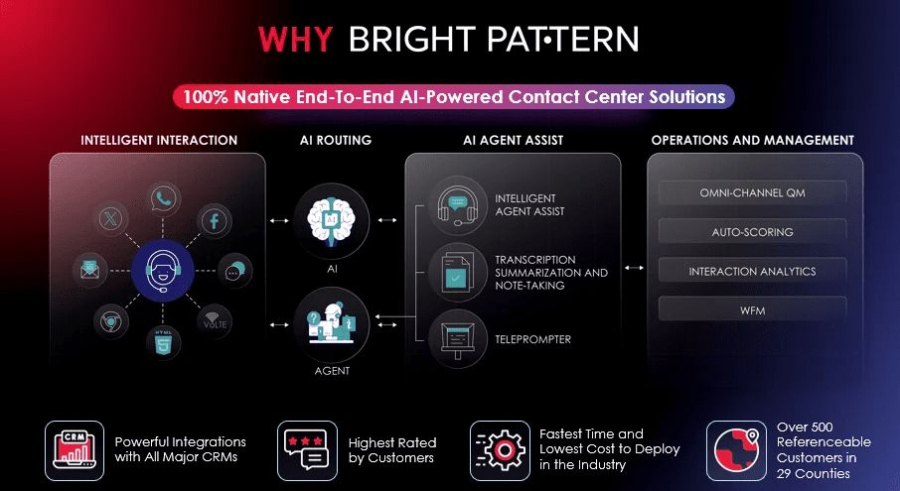
Bright Pattern is widely regarded as one of the most advanced AI-enabled call center platforms available today, with a complete focus on customer experience, agent empowerment, and seamless automation. Its design philosophy centers around simplifying complex interactions while delivering enterprise-grade performance.
Unified Omnichannel Experience
One of Bright Pattern’s core strengths is its true omnichannel architecture. Whether customers connect via voice calls, SMS, live chat, social messaging (like Facebook Messenger or WhatsApp), or email, all interactions are tracked in a single interface. This eliminates silos between channels and creates a continuous conversation thread that agents can follow without missing context — drastically improving customer satisfaction.
AI-Powered Intelligent Routing
Bright Pattern’s AI doesn’t simply push calls to the next available agent — it analyzes intent, historical interactions, preferences, and even customer sentiment to route calls to the best possible agent. This leads to faster resolution times and higher first-call resolution rates, which are critical KPIs for modern contact centers.
Real-Time Agent Assistance
Agents using Bright Pattern benefit from built-in AI assistance features. These include:
- Real-time suggestions during live calls
- Automated call summaries and next-step recommendations
- Sentiment scoring that flags escalating issues
- Intelligent prompts for FAQs and relevant knowledge base articles
This support layer reduces agent onboarding time and dramatically improves consistency across interactions.
Predictive Analytics & Performance Dashboards
Bright Pattern’s analytics suite goes beyond standard call metrics. The platform uses AI to predict trends, forecast call volumes, and identify training gaps. Managers gain actionable insights through intuitive dashboards that highlight customer experience trends, agent performance, and operational bottlenecks.
Flexible Deployment & Scalability
Whether your business is just starting with AI or scaling globally, Bright Pattern’s cloud-native architecture adapts to your needs. It integrates seamlessly with popular CRMs (like Salesforce and Zendesk), workforce management tools, and other enterprise systems, enabling a modular approach that grows with your organization.
Customer Success and Support
Bright Pattern emphasizes not just software delivery — but long-term partnership. Clients often cite personalized onboarding, proactive support, and ongoing optimization guidance as reasons they stay with the platform long-term.
Why Businesses Choose Bright Pattern
- Comprehensive AI that enhances both agent and customer experiences
- True omnichannel capabilities in one unified platform
- Robust real-time and predictive analytics
- Intelligent automation that reduces wait times and manual tasks
- Scalable architecture for businesses of all sizes
Because of these strengths, Bright Pattern consistently ranks as a leading solution for companies aiming to modernize their contact centers with AI — all while improving key service metrics and ROI.
2. Genesys Cloud CX – Comprehensive AI Capabilities
Genesys Cloud CX provides tools for forecasting, automation, and advanced analytics, backed by AI-powered bots and virtual assistants. Its AI helps predict customer intent, streamline workflows, and optimize agent performance. While it’s feature-rich and powerful for large organizations, some users find it more complex to deploy compared to more streamlined platforms.
3. Talkdesk – AI with Focus on Efficiency and Insights
Talkdesk’s AI suite includes automated call summarization, sentiment analysis, and predictive SLA management. The system helps improve agent productivity by automating repetitive tasks and providing real-time recommendations. Talkdesk’s strengths lie in its ease of use and speed of deployment, making it a popular choice for mid-sized businesses.
4. Five9 – AI to Boost Productivity and Personalization
Five9 leverages AI to enhance agent desktop workflows, predict customer preferences, and automate routing. It also offers virtual agents and intelligent callback scheduling to reduce abandonment rates. For businesses focused on improving outbound campaigns alongside inbound support, Five9 offers strong AI capabilities — especially in predictive dialing and automation.
5. Zendesk AI – Smart Support within a Unified Helpdesk
Zendesk incorporates AI into its support suite to automate ticket triage, suggest responses, and analyze conversational trends. While Zendesk isn’t solely a call center platform, its AI dramatically reduces manual work for support teams and scales help across multiple channels. It’s often chosen by businesses that want AI-powered helpdesk + call support in one ecosystem.
6. Cisco Contact Center AI – Secure and Enterprise-Class
Cisco’s AI solutions focus on combining reliable call center infrastructure with AI-driven automation. Features include natural language understanding, virtual agents, and analytics that help reduce call volume and improve routing accuracy. Cisco’s solution appeals to large enterprises requiring strong security, global reach, and deep networking integration.
7. Twilio Flex + AI – Customizable and Developer-Friendly
Twilio Flex empowers businesses to build custom contact center experiences with modular AI tools. With programmable AI routing, chatbots, and voice assistants, companies with technical teams can tailor every aspect of the customer journey. While more developer-heavy, Twilio Flex offers unmatched flexibility and innovation potential.
8. HubSpot Service Hub – AI to Empower Support Teams
HubSpot’s Service Hub includes AI-powered automation for ticket routing, knowledge base suggestions, and performance analytics. It’s especially appealing for small to mid-sized companies already using HubSpot CRM, as the AI seamlessly enhances customer experience and internal workflows without complex setups.
High-impact use cases (and the outcomes teams aim for)
1) Conversational AI for self-service
Conversational AI (voice bots and chatbots) can handle common, repeatable requests such as order status, appointment scheduling, password resets, account updates, and basic troubleshooting. The goal isn’t to replace human agents; it’s to resolve simple issues quickly and free agents for complex, higher-value conversations.
Common positive outcomes include:
- Shorter customer wait times during peak periods
- 24/7 coverage for frequently asked questions
- More consistent answers for standard policies and processes
- Smoother handoffs to agents with context captured upfront
2) AI-powered routing and intent detection
AI routing uses signals like customer intent, language, customer profile, and historical interaction patterns to send contacts to the best queue or agent group. When implemented well, this improves the customer experience by reducing transfers and getting customers to the right help faster.
Teams typically look for benefits such as:
- Fewer misroutes and fewer repeat explanations
- Faster time-to-resolution for specialized issues
- Better workload balancing across teams
3) Real-time agent assist
Agent assist tools support representatives during live calls or chats by surfacing suggested responses, relevant knowledge base articles, policy snippets, and next-best actions. This is especially valuable for new hires and for complex product portfolios.
Where agent assist shines:
- Faster answers without putting customers on hold
- More consistent messaging aligned to approved policies
- Confidence and performance lift for ramping agents
- Lower cognitive load during high-pressure interactions
4) Automated call summaries and after-call work
After-call work can quietly consume a large portion of an agent’s day. AI-generated summaries and structured fields can reduce manual note-taking and help ensure that the next person who touches the case sees a clear, consistent record.
Typical improvements include:
- More time spent talking to customers, less time typing
- Cleaner case documentation for follow-ups and escalations
- More reliable handoffs between teams
5) Quality management and coaching at scale
AI can assist quality teams by automatically analyzing interactions for coaching opportunities, compliance checks, sentiment indicators, and conversation patterns. Rather than sampling a small fraction of calls, teams can review a broader set of interactions and focus human attention where it matters most.
Benefits organizations aim for:
- More consistent QA coverage across agents and shifts
- Faster detection of training needs and process gaps
- Targeted coaching that improves customer outcomes
6) Workforce optimization support
Some AI-enabled workforce tools can improve forecasting and scheduling by learning seasonal patterns, channel shifts, and contact drivers. The objective is better staffing alignment, which supports both customer experience and agent wellbeing.
How call center AI solutions fit into the end-to-end workflow
It helps to map AI to the customer journey, so you can prioritize the quickest wins.
| Journey stage | AI capability | What it improves |
|---|---|---|
| Before contact | Proactive digital assistants, knowledge base search | Deflection of simple questions, better self-serve success |
| At contact | Intent detection, smart IVR, smart routing | Fewer transfers, quicker connection to the right team |
| During interaction | Real-time agent assist, translation, policy guidance | Faster answers, consistent messaging, reduced hold time |
| After interaction | Auto summaries, disposition suggestions, CRM field capture | Less after-call work, stronger documentation, better follow-up |
| Continuous improvement | Conversation analytics, QA automation, coaching insights | Better training, improved processes, higher service consistency |
Key benefits to highlight when building a business case
If you’re socializing AI internally, align benefits to outcomes your stakeholders already care about: customer experience, efficiency, risk management, and employee experience.
Customer experience improvements
- Faster resolutions through better routing and agent assist
- More consistent answers by guiding agents with approved knowledge
- Less repetition via context capture and clean handoffs
- Expanded availability with self-service coverage outside business hours
Operational efficiency gains
- Reduced after-call work with AI summaries and structured capture
- Improved handle time by accelerating information retrieval
- More scalable QA through automated analysis and prioritization
Agent experience and performance
- Faster ramp for new hires with guided prompts and next steps
- Lower stress during difficult calls with real-time support
- Better coaching driven by consistent conversation insights
Consistency, governance, and compliance support
- Stronger policy adherence via guided scripts and knowledge prompts
- Improved documentation for audits and escalations
- Early detection of recurring issues that require process updates
What to look for in a call center AI solution (selection checklist)
Not every AI feature delivers the same value in every environment. Use this checklist to evaluate fit, scalability, and adoption readiness.
Product capabilities
- Channel support: voice, chat, email, messaging, and the ability to share context across them
- Real-time assistance: live suggestions during calls, not only post-call analytics
- Strong summarization: clear, editable summaries with structured fields
- Knowledge integration: connects to your existing knowledge base and respects permissions
- Handoff design: bot-to-agent transitions that preserve intent and history
Integration and data readiness
- CRM and ticketing integration to write back summaries and tags
- Contact center platform compatibility with your telephony and routing setup
- Data mapping for disposition codes, case fields, and customer profiles
Security and governance essentials
- Role-based access for agents, supervisors, QA, and administrators
- Data retention controls aligned with your internal policies
- Auditability for changes to prompts, knowledge sources, and workflows
- PII handling features (redaction or masking where appropriate)
Operational usability
- Supervisor controls to tune suggestions and manage knowledge quality
- Clear reporting tied to KPIs you already track
- Agent experience that reduces clicks and friction instead of adding steps
Implementation roadmap: a practical, low-disruption approach
Successful deployments typically treat AI as a workflow improvement program, not a one-time tool installation. A phased rollout helps build trust, drive adoption, and show measurable wins quickly.
Phase 1: Baseline, scope, and quick wins
- Choose one or two high-volume contact drivers (for example: billing questions, order status, appointment changes).
- Define success metrics and establish a baseline from current reporting.
- Start with agent assist and auto summaries if you want minimal customer-facing risk while delivering immediate productivity gains.
Phase 2: Knowledge and workflow design
- Clean up knowledge articles: concise titles, clear steps, and approved language.
- Define when AI suggests actions and when it stays silent (avoiding noise improves trust).
- Design escalation paths for sensitive issues and exceptions.
Phase 3: Pilot with a representative team
- Run a pilot with a mix of tenured agents and newer hires.
- Collect feedback weekly and refine suggested responses, knowledge links, and summary templates.
- Enable supervisors to review interactions for coaching opportunities.
Phase 4: Expand channels and automate more
- Introduce conversational self-service for the most repeatable intents.
- Add smart routing once intent detection is reliable.
- Scale QA automation to prioritize review queues.
Phase 5: Continuous optimization
- Monitor new contact drivers and update knowledge routinely.
- Refresh prompts and templates when policies change.
- Use conversation insights to fix root causes, not just symptoms.
KPIs to track for a clear, credible ROI story
Pick a focused set of metrics that link directly to service goals. You can expand later, but early measurement should be simple and consistent.
Efficiency metrics
- Average handle time (AHT) and its components (talk time vs. after-call work)
- Time to first response for digital channels
- Containment rate for self-service flows (where appropriate)
Customer experience metrics
- First contact resolution (FCR)
- Customer satisfaction (CSAT) or post-interaction survey results
- Transfer rate and repeat contact rate
Quality and consistency metrics
- QA scores and specific compliance checks relevant to your industry
- Documentation completeness (for example: required fields populated)
Agent experience metrics
- Ramp time for new hires (tracked through proficiency milestones)
- Adoption rate of AI features (summary usage, suggested article opens)
Success stories (realistic examples you can model)
Every call center is different, but the most successful programs share a common theme: they align AI to concrete workflows and measure outcomes consistently. Here are examples of what “good” can look like when implemented thoughtfully.
Example 1: Retail support team improves speed and consistency
A retail customer service team introduces AI agent assist that surfaces return policy rules, order lookup steps, and shipping timelines based on the customer’s intent. Supervisors also standardize AI-generated summaries into a consistent format.
- Agents spend less time searching for policy pages.
- Customers get clearer, more consistent answers during peak seasons.
- Cases are easier to follow for escalations and callbacks.
Example 2: Service scheduling center increases self-serve completion
A scheduling-heavy service center launches conversational AI for appointment booking and rescheduling, with a clean escalation to agents when requests fall outside normal rules.
- Routine scheduling requests are handled quickly without waiting.
- Agents focus on complex cases and exceptions.
- Customer intent and details are captured upfront, reducing repetition.
Example 3: B2B help desk boosts onboarding and coaching
A B2B help desk uses AI to suggest troubleshooting steps during calls and to tag common incident categories. QA uses conversation analytics to identify training opportunities by topic.
- New agents ramp faster with in-the-moment guidance.
- Supervisors coach based on consistent themes rather than isolated anecdotes.
- Knowledge gaps become visible and easier to fix.
Common deployment best practices that drive adoption
Call center AI works best when agents see it as a helpful teammate rather than an extra layer of complexity. These practices support strong adoption and steady improvement.
- Keep humans in control: make suggestions editable and ensure agents can override.
- Start where it helps agents immediately: summaries and knowledge surfacing often deliver quick value.
- Make knowledge a product: assign owners, review cycles, and clear writing standards.
- Coach with consistency: use AI insights to reinforce strengths and share winning behaviors.
- Operationalize feedback: create a simple path for agents to flag wrong or outdated suggestions.
A quick decision guide: which AI capability should you start with?
If you want a simple way to prioritize, match your most pressing objective to a starting capability.
| Your top priority | Best starting point | Why it’s a strong first step |
|---|---|---|
| Reduce after-call work | AI summaries and structured disposition support | Immediate time savings with minimal customer-facing change |
| Improve consistency and policy adherence | Agent assist with approved knowledge prompts | Guides agents in real time and reinforces best practices |
| Lower transfers and speed up connection | Intent detection and smart routing | Gets customers to the right resource faster |
| Handle high volumes of repetitive questions | Conversational AI self-service | Resolves routine issues quickly and frees agents for complex work |
| Scale quality monitoring | Conversation analytics and QA automation | Expands coverage and focuses human review where it matters |
Conclusion: AI-enabled call centers are built, not bought
The strongest call center AI solutions deliver results when they’re paired with solid workflows, clean knowledge, and a phased rollout that earns trust. Start with the use cases that remove friction for agents and customers, measure what matters, and optimize continuously.
When implemented thoughtfully, AI becomes a practical advantage: faster resolutions, more consistent service, and a support operation that scales without sacrificing the human touch customers still value most.
